Most people do not think about their nervous system when life is going well.
We think about the brain when we need to concentrate.
We think about muscles when we exercise.
We think about digestion when something feels off.
We think about sleep when we cannot get enough of it.
We think about stress when we finally feel overwhelmed.
But behind all of this, your nervous system is quietly working in the background like an internal autopilot.
And thank goodness for that, because imagine if you had to consciously remember to keep your heart beating, adjust your blood pressure, regulate your breathing, digest your lunch, manage your temperature, scan your environment, coordinate your movement and decide whether your body should prepare for action or recovery.
You would not get much done.
Your nervous system is constantly helping your body respond to life.
It adjusts your heart, lungs, digestion, blood pressure, temperature, muscles, attention and energy without asking you for permission first. It is not passive. It is always reading, filtering and responding.
This is why your nervous system matters so much.
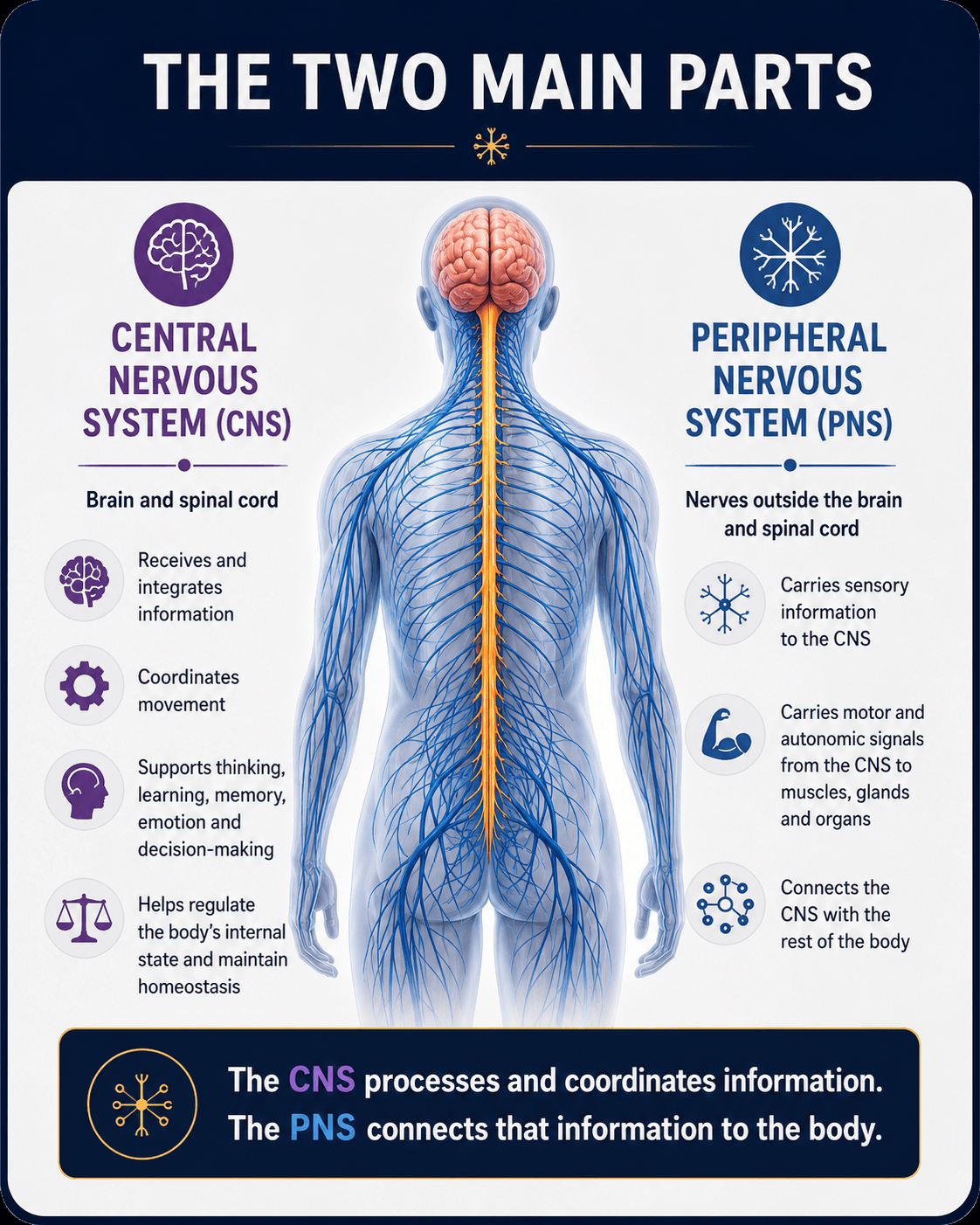
It is not only involved when you feel stressed, anxious, exhausted or burnt out. It is involved in how you wake up, how you recover, how you focus, how you react, how you sleep, how you digest, how you move, how you connect with others and how you perform under pressure.
A healthy nervous system is not calm all the time.
That is one of the biggest misunderstandings.
You do not want a nervous system that is permanently relaxed. You want one that is flexible.
It should be able to rise when life asks for action, focus, strength or performance, and then return towards recovery when the demand has passed.
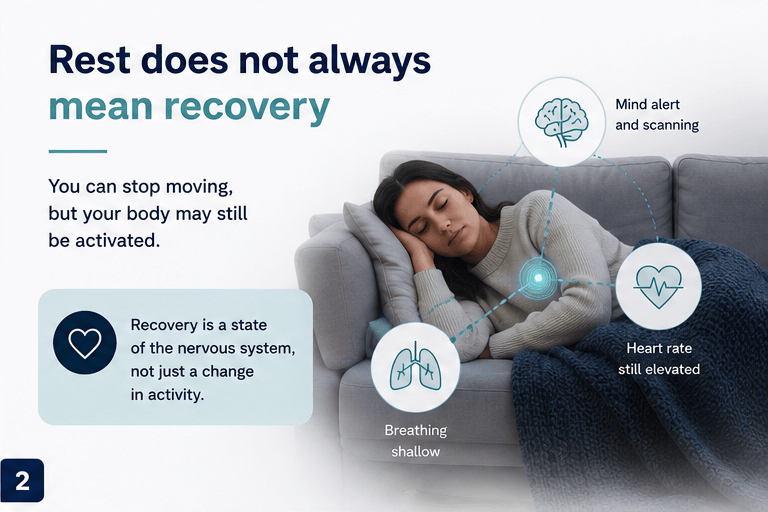
Because rest does not always equal recovery.
You can sit on the sofa and still feel activated.
You can stop working and still feel your body rushing inside.
You can lie in bed exhausted and still feel your mind scanning through tomorrow.
You can go on holiday and realise your body has not actually switched off.
That does not always mean you are addicted to work or bad at relaxing.
Sometimes your system has simply learned that staying alert feels safer than softening.
And this is where nervous system understanding becomes powerful, because your nervous system is not just part of your stress response. It is part of your performance system too.
It influences your attention, decision-making, emotional control, recovery and creativity.
So before we talk about stress management, performance, burnout prevention, recovery or resilience, we need to understand the system underneath all of them.
Your nervous system is the base.
What is the nervous system?
The nervous system is the body’s main communication, control and coordination network.
It allows the brain and body to exchange information continuously, so we can sense what is happening, interpret it, respond appropriately, and maintain internal balance.
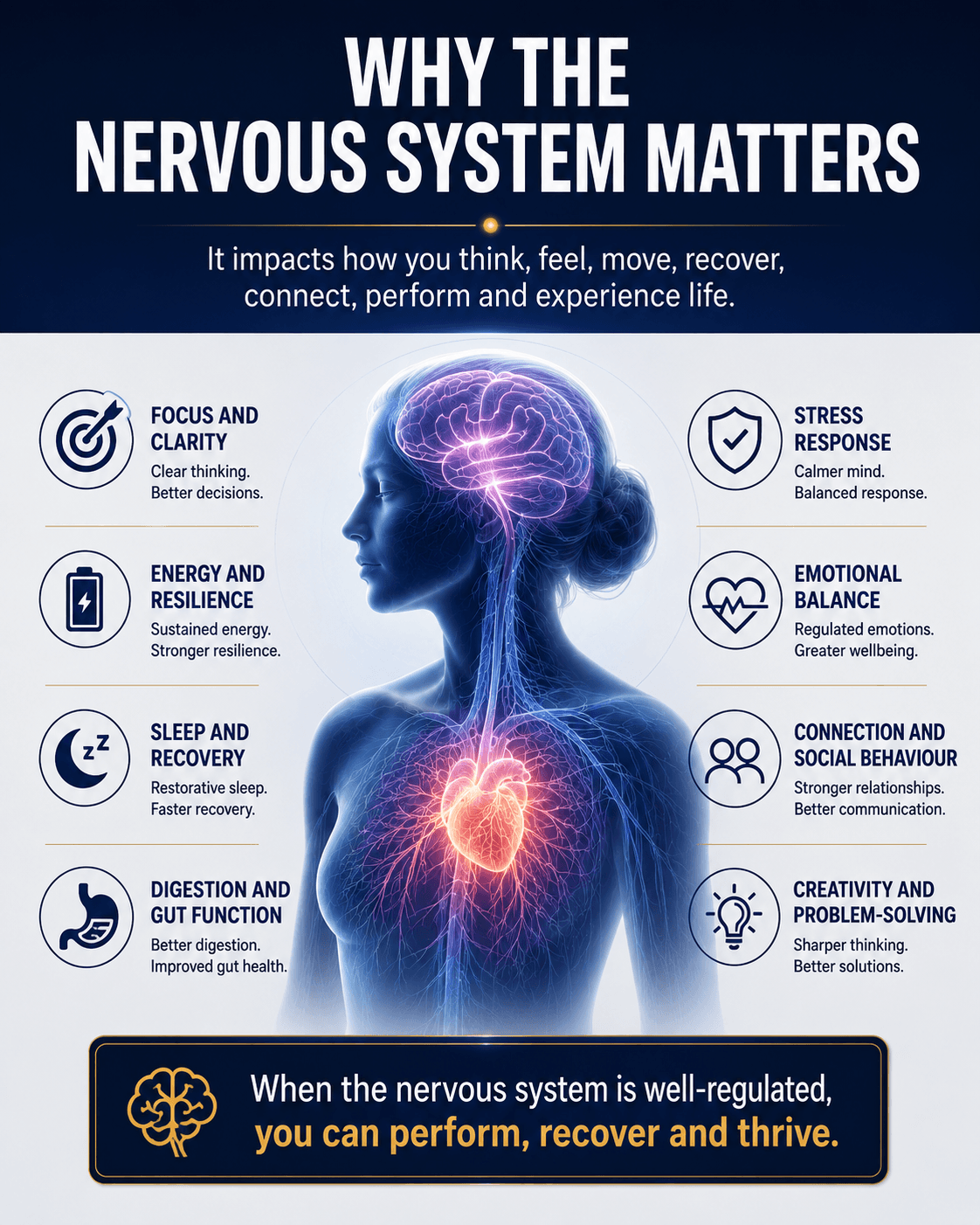
Scientifically, the nervous system is usually divided into two main parts:
The central nervous system (CNS)
This includes the brain and spinal cord. The CNS receives and integrates information, coordinates movement, supports thinking, learning, memory, emotional processing and decision-making, and helps regulate the body’s internal state.
The peripheral nervous system (PNS)
This includes the nerves outside the brain and spinal cord. The PNS carries information between the central nervous system and the rest of the body, including the muscles, skin, joints, organs and glands.
In simple terms, the central nervous system processes and coordinates information, while the peripheral nervous system connects that information to the body.
This is why the nervous system is not only involved in thinking or movement. It is involved in almost every function that allows a human being to sense, respond, regulate, adapt, recover and survive.
It helps you notice pain, move your body, coordinate balance, regulate organs, process emotions, respond to pressure, recover after effort and adapt to changing demands.
What is the nervous system responsible for?
The nervous system is involved in both voluntary actions, such as movement, and automatic physiological processes, such as heart rate, breathing and digestion.
It supports several key areas of human function:
Sensation
This includes touch, pain, temperature, pressure, proprioception, body position and internal body signals.
Movement and coordination
This includes voluntary movement, posture, balance, reflexes, muscle control and coordination.
Cognition
This includes attention, learning, memory, planning, problem-solving and decision-making.
Emotion and behaviour
This includes emotional processing, motivation, threat detection, social behaviour and behavioural responses.
Autonomic regulation
This includes automatic body functions such as heart rate, blood pressure, respiration, digestion, sweating, temperature regulation and sexual arousal.
Homeostasis and adaptation
Homeostasis means maintaining internal physiological balance. The nervous system helps the body adapt to changing internal and external demands, so we can respond to life while keeping essential systems stable.
This is why the nervous system is so important.
It is not a small separate system that only matters when something goes wrong. It is one of the main biological systems that allows the body to stay alive, respond to stress, recover, perform, connect, learn and adapt.
A more human way to say it:
Your nervous system is the system that helps your body understand what is happening, decide what matters, and coordinate the response.
That response may be movement, focus, protection, recovery, digestion, emotional regulation, alertness or rest.
This is the foundation for understanding stress, energy and recovery. Because if the nervous system is constantly receiving signals of demand, pressure or threat, the body may spend more time preparing for action than returning to restoration.
The autonomic nervous system: the part running in the background
One part of the nervous system is especially important when we talk about stress, recovery, energy and performance.
This is the autonomic nervous system, often shortened to ANS.
The autonomic nervous system is part of the peripheral nervous system and helps regulate many bodily processes that typically occur without conscious control.
In other words, it is doing a lot of work while you are busy living your life.
You do not have to remind your heart to beat.
You do not have to manually adjust your blood pressure when you stand up.
You do not have to consciously control your pupils, sweating, digestion or body temperature every minute of the day.
Your autonomic nervous system helps coordinate these processes for you.
It is involved in regulating:
- heart rate
- blood pressure
- breathing and respiration
- digestion
- sweating
- pupil responses
- body temperature regulation
- sexual arousal
- some metabolic and organ functions
This is why the autonomic nervous system is so relevant to everyday life.
It helps your body respond to pressure, recover after demand, digest food, regulate cardiovascular activity and maintain internal balance.
When people talk about feeling “wired”, “shut down”, “overstimulated”, “unable to switch off” or “not fully recovered”, we are often looking at patterns connected with this autonomic regulation system.
Scientifically, the autonomic nervous system is usually described as having three main divisions:
- the sympathetic nervous system
- the parasympathetic nervous system
- the enteric nervous system, which is strongly involved in gut function
For stress, recovery and performance, we usually focus most on the sympathetic and parasympathetic branches.
And this is where many people get the wrong idea.
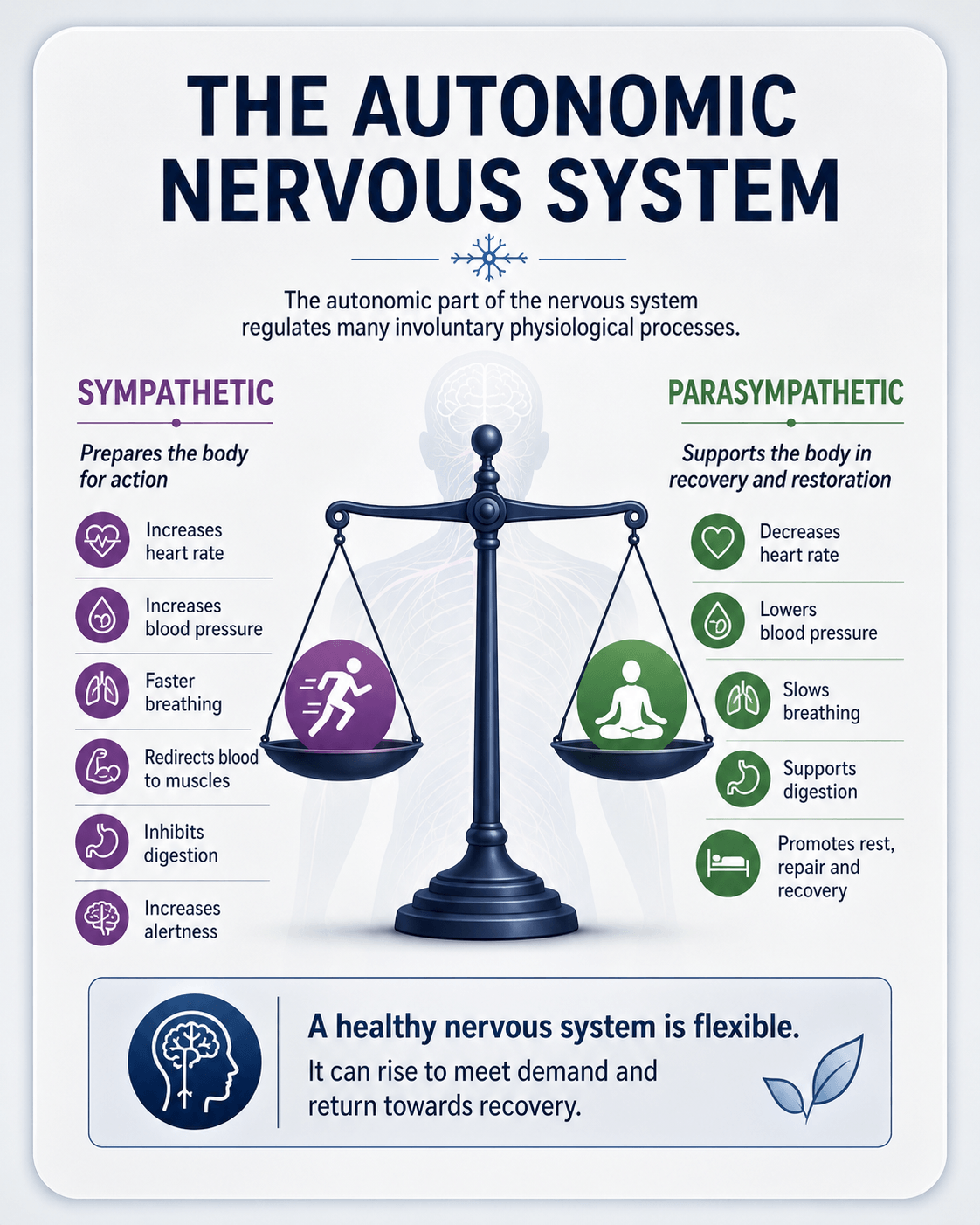
The sympathetic nervous system: your mobilisation system
The sympathetic nervous system is commonly linked with the fight-or-flight response, but it is much more than an emergency alarm.
It is your mobilisation system.
It helps prepare the body for action, effort, challenge, protection and performance.
When sympathetic activity increases, the body may show changes such as:
- increased heart rate
- increased blood pressure
- increased alertness
- changes in breathing
- greater glucose and energy mobilisation
- increased muscle readiness
- sweating
- pupil dilation
- reduced digestive activity
This can sound intense, but it is not automatically a bad thing.
You need sympathetic activation to exercise, speak in public, run for the bus, compete in sport, lead a meeting, respond quickly, stay alert, take action and perform under pressure.
Without it, you would not rise to meet life.
So the sympathetic nervous system is not the villain.
The problem is not activation itself.
The problem begins when activation becomes too frequent, too prolonged, poorly regulated, or not followed by enough recovery.
That is when the body may stay in a state of internal readiness even after the situation has passed.
The meeting is over, but your body is still preparing.
The workout is finished, but your system has not settled.
The child is finally asleep, but your mind is still scanning.
The deadline has passed, but your chest, jaw or stomach still feel like something is coming.
This is why stress is not only about what happens to you.
It is also about whether your body can complete the response and return towards recovery.
The parasympathetic nervous system: your recovery and restoration system
The parasympathetic nervous system is often described as the rest-and-digest system.
That phrase is useful, but it is also a little too simple.
The parasympathetic system supports restoration, digestion, energy conservation and recovery. It helps the body return towards steadiness after activation.
Parasympathetic activity is involved in:
- slowing heart rate
- supporting digestion
- supporting recovery
- supporting restoration
- supporting energy conservation
- helping the body return towards baseline after activation
A major pathway of the parasympathetic nervous system is the vagus nerve.
The vagus nerve plays an important role in communication between the body and the brain, especially by transmitting signals from internal organs. This is one of the reasons body state, emotional state, digestion, breathing and recovery can feel so connected.
But again, we need to be scientifically careful.
It is too simplistic to say:
sympathetic = bad
parasympathetic = good
That is not how the body works.
You need both.
A healthy nervous system is not permanently calm. It is adaptable.
It can mobilise when needed.
It can recover when the demand has passed.
It can prepare for action without staying trapped in action.
It can rest without shutting down.
It can respond to life with flexibility.
That flexibility is the important part.
Because real regulation is not about being calm all the time.
It is about being able to move between states in a way that matches what life is asking from you.
A healthy nervous system can rise in response to pressure, effort and performance, then return towards recovery, digestion, repair and restoration.
And when that flexibility becomes reduced, daily life can start to feel harder than it should.
So what does this mean in real life?
When your nervous system is flexible, it can move between different states more smoothly.
It can help you wake up and prepare for the day.
It can help you focus when something matters.
It can help you respond to pressure.
It can help you digest food, recover after effort, sleep, connect with people and return towards balance after demand.
But when that flexibility is reduced, life can begin to feel more effortful.
Not always dramatically.
Sometimes it is subtle.
You may still be working, parenting, training, leading, creating, caring and getting things done. From the outside, everything may look fine.
But inside, your system may be spending too much time in activation and not enough time in restoration.
This may look like:
- sitting down to rest, but not feeling truly rested
- lying in bed tired, but still feeling alert inside
- feeling reactive faster than you used to
- noticing tension in your jaw, shoulders, chest, stomach or back
- struggling to focus, even when you care about what you are doing
- feeling foggy, flat or overstimulated
- digesting differently when life becomes busy
- needing longer to recover from normal demands
- feeling productive, but not fully restored
- finding it hard to switch off even when nothing urgent is happening
This is why nervous system work matters.
Because the question is not only:
“Am I resting?”
The better question may be:
“Is my body actually entering recovery?”
And the question is not only:
“Can I keep going?”
It is also:
“Can my system recover from what I am asking it to do?”
A small note about stress
Stress fits into this picture because stress is one type of demand your nervous system responds to.
But it is not the whole story.
Your nervous system also responds to sleep, pain, movement, food, breathing, hormones, emotional conversations, uncertainty, social connection, workload, memories, illness, environment and recovery.
So, in this article, we are not going into stress in depth yet.
Stress deserves its own article because much more is happening beneath the surface than most people realise. We will come back to adrenaline, cortisol, recovery, inflammation, chronic pressure and why two people can experience the same situation very differently.
For now, the important point is simpler:
Your nervous system is constantly helping you adapt to life. Stress is only one part of that bigger picture.
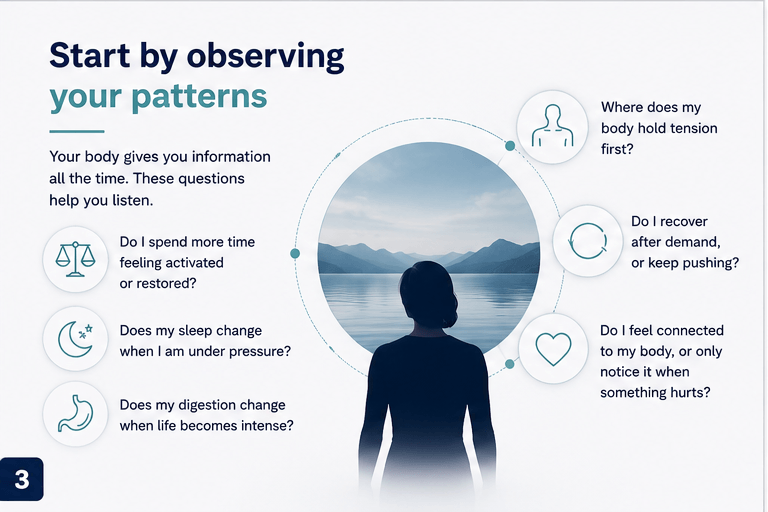
Start by observing your own patterns
A helpful first step is not to diagnose yourself or overanalyse every signal.
Just start noticing.
You can ask yourself:
Do I spend more time feeling activated or restored?
Can I switch off after work, training, parenting or responsibility, or does my body stay “on”?
Does rest actually feel restorative, or do I stop moving while still feeling busy inside?
How does my sleep change when I am under more pressure?
How does my digestion respond when life becomes intense?
Where does my body hold tension first: jaw, shoulders, chest, stomach, back or head?
Do I recover after demand, or do I keep going until I crash?
Do I feel connected to my body, or do I only notice it when something becomes uncomfortable?
Do I move smoothly between action and recovery, or do I get stuck in one mode?
These questions are not there to judge you.
They are there to help you listen.
Because your body is giving you information all the time.
Why this matters
Understanding your nervous system gives you a more intelligent way to understand your body.
Instead of immediately asking:
“What is wrong with me?”
you can begin asking:
“What is my body responding to?”
That question changes the tone of everything.
It moves you from self-judgement into curiosity.
It helps you recognise whether your system may need more recovery, more rhythm, more movement, more rest, more safety, more support, or a different way of working with pressure.
A healthy nervous system is not calm all the time.
It is flexible.
It can rise when life asks for action, focus, strength or performance.
It can return when the demand has passed.
It can help you move through life with more steadiness, energy, clarity and resilience.
When you do not know where to start
Sometimes you can feel that something is “off”, but you cannot quite understand what your body is trying to tell you.
This is where guided support can help.
HRV monitoring and heart coherence training can offer a practical way to observe how your body responds to breath, focus, activation and recovery.
It is not about diagnosing you.
It is about helping you understand your patterns more clearly, so you can begin supporting your nervous system in a way that is personal, realistic and useful.
If you would like to better understand your own nervous system, we are here to help.
And in the next article, we will look more deeply at stress itself: what it really does in the body, why it is not always bad, and why recovery is often the missing piece.
Karolina Skulska- Be Super You 🙂