
In the previous article, we examined the nervous system as the body’s communication and regulatory network.
The system that helps you breathe, digest, move, focus, sleep, recover, react, connect, protect yourself and perform under pressure.
Now that we understand that, stress starts to make much more sense.
Because stress is not just a mood.
It is not only “I feel overwhelmed.”
It is not simply a thought in the mind.
Stress begins when your body detects a demand and decides that something requires adaptation.
That demand may come from the outside world.
A deadline.
A difficult conversation.
A competition.
A financial pressure.
A noisy environment.
A full inbox.
A demanding client.
A child needing you when you are already tired.
A meeting where you need to stay sharp.
But demand can also come from inside the body.
Pain.
Inflammation.
Poor sleep.
Blood sugar swings.
Hormonal changes.
Illness.
Overtraining.
Under-eating.
Emotional suppression.
Constant worry.
The feeling that you have been carrying too much for too long.
This is why stress is not one thing.
To the body, stress is anything that requires extra energy, adjustment, protection, repair, mobilisation, or recovery.
And this is where stress becomes much more interesting than simply saying, “I am stressed.”
Because the same stressor can build one person and overload another.
The same pressure can sharpen one nervous system and dysregulate another.
The same challenge can become resilience in one body and damage in another.
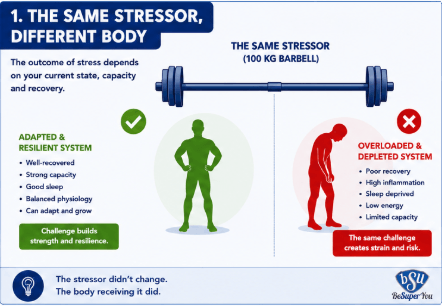
The same stressor, a different body
Imagine a 100 kg barbell.
For a trained, well-recovered athlete, that weight may be part of a strengthening process. The body meets the demand, responds, repairs and gradually becomes stronger.
For someone exhausted, injured, inflamed, sleep-deprived or physically unprepared, the same barbell may be too much. It may create strain, pain or injury.
The barbell did not change.
The body receiving the load did.
Stress works in a similar way.
A cold shower may help one person feel focused, awake and energised. For another person, especially someone already exhausted or anxious, it may feel like one more shock to a system that is already struggling to settle.
A fast may feel clear and stabilising for one body, but destabilising for another if blood sugar regulation, hormones or energy availability are already under pressure.
A hard training session may build capacity in one person and push another into days of fatigue.
A presentation may help one person rise into focus and performance, while another person goes blank and loses access to clear thinking.
This does not mean one person is strong and the other is weak.
It means they are not starting from the same internal state.
Stress response is influenced by many layers:
sleep quality
nutrition
blood sugar regulation
inflammation
pain
hormonal state
fitness level
training history
emotional load
previous stress exposure
current illness
recovery habits
social support
nervous system flexibility
the amount of pressure already being carried
This is why your stress response is almost like a fingerprint.
It belongs to your body, your history, your current physiology and the exact moment you are in.
Stress is not only psychological
One of the biggest mistakes we make is separating “mental stress” from “physical stress” as if the body sees them as completely different things.
It does not.
A difficult emotional conversation can change your breathing, muscle tension, heart rate, digestion and sleep.
Poor sleep can make you more emotionally reactive the next day.
Pain can make your nervous system more vigilant.
Inflammation can influence fatigue, mood, motivation and concentration.
Blood sugar instability can affect irritability, focus and energy.
Constant anticipation can keep the body preparing for something, even when nothing is physically happening in that moment.
This is why stress is not “all in your head.”
Stress is a whole-body event.
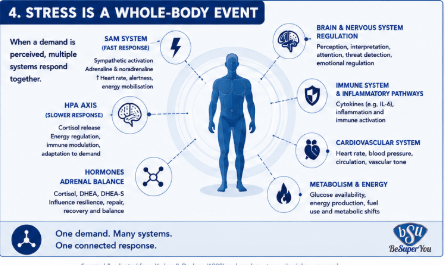
When the body perceives a demand, several systems can become involved simultaneously.
The nervous system helps create the fast response.
The endocrine system helps coordinate hormonal responses.
The cardiovascular system changes heart rate and blood pressure.
The respiratory system changes breathing.
Metabolism shifts energy availability.
The immune system and inflammatory pathways may also become involved, especially when stress is repeated, prolonged or layered onto illness, pain or poor recovery.
One of the fast stress pathways is the sympathetic-adreno-medullary system, often shortened to the SAM system.
This is your rapid mobilisation response.
The sympathetic nervous system activates. Adrenaline and noradrenaline increase. Heart rate may rise. Blood pressure may shift. Alertness increases. Glucose becomes more available. Muscles become more ready for action.
This is not bad.
You need this system to perform.
You need it to exercise, compete, speak, lead, react quickly, protect yourself, meet a challenge or focus when something matters.
Another important pathway is the hypothalamic-pituitary-adrenal axis, known as the HPA axis.
This is a slower hormonal stress pathway involving cortisol.
Cortisol has been cast as a villain in many online conversations, but it is not inherently bad. It is essential.
It helps with energy regulation, immune modulation, metabolism, circadian rhythm and adaptation to demand.
The problem is not cortisol itself.
The problem begins when stress systems are activated too often, too intensely or for too long without enough recovery.
The adrenal glands also produce DHEA and DHEA-S. These hormones are often discussed in relation to resilience, repair, neuroprotection and anabolic balance. This matters because stress physiology is not simply “high cortisol equals bad.”
The wider pattern matters.
Two people may both experience stress, but one body may recover and reorganise well afterwards, while another remains in a more costly physiological state for longer.
That is why context matters.
Pressure can become resilience or damage
Stress does not automatically damage the body.
Some stress is part of growth.
Exercise is stress.
Learning is stress.
Competition is stress.
Skill development is stress.
Cold exposure is stress.
Heat exposure is stress.
Public speaking is stress.
Starting a business is stress.
Changing your life is stress.
The body adapts through challenge.
This is connected to the concept of hormesis: the idea that the right dose of stress can stimulate beneficial adaptation.
Muscles strengthen after appropriate resistance training.
Bones adapt to load.
The cardiovascular system adapts to exercise.
Skills improve through challenge and repetition.
Confidence can grow through manageable exposure to pressure.
But there is one important condition.
A stressor only becomes resilience-building when the body can complete the adaptation cycle.
Challenge must be followed by recovery.
Activation must be followed by return.
Demand must be matched by enough capacity.
Otherwise, stress does not become growth.
It becomes load.
The two possible pathways through pressure
This is where stress and performance become deeply connected.
Pressure is not always optional.
Life brings pressure.
Work brings pressure.
Leadership brings pressure.
Family brings pressure.
Sport brings pressure.
Growth brings pressure.
The question is not whether pressure exists.
The question is what pathway the body takes through it.
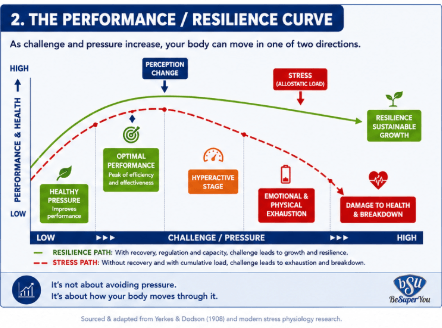
One pathway moves towards resilience.
In this pathway, the challenge is present, but the person has sufficient capacity, recovery, regulation, and support to move through it. The body rises, responds, learns, repairs and returns.
Pressure becomes part of adaptation.
The person may even become stronger, clearer and more capable because of it.
The other pathway moves towards cumulative stress load.
In this pathway, pressure is repeated, prolonged, poorly recovered from or layered on top of too many other demands. The body keeps mobilising, but does not fully return.
At first, the person may still function.
They may work, train, lead, care, create and perform.
They may look fine.
But inside, the body may be spending more time in protection, vigilance and compensation.
Eventually, this can manifest as hyperactivation, emotional exhaustion, physical fatigue, reduced recovery, poor sleep, inflammation, hormonal disruption, burnout patterns, or health damage.
This is not because the person is weak.
It is because the body has been asked to adapt for too long without enough restoration.
Allostasis: the cost of adapting
The body is constantly adjusting itself to keep you alive and functioning.
Your heart rate changes.
Your blood pressure changes.
Your breathing changes.
Your hormones change.
Your immune activity changes.
Your glucose availability changes.
Your nervous system state changes.
This process is called allostasis.
Allostasis means maintaining stability through change.
It is intelligent.
It is necessary.
It is how the body adapts to life.
But adaptation has a cost.
When the body has to keep adjusting again and again without enough recovery, the cost begins to accumulate.
This is called allostatic load.
A simple way to understand it is:
Allostasis is the body adapting.
Allostatic load is the wear and tear that can build when adaptation is demanded too often, too intensely or for too long.
This is why “I am coping” is not always the same as “I am recovered.”
You can be functioning and still be carrying load.
You can be productive and still be depleted.
You can look calm while your body is working very hard beneath the surface.
The modern problem: stress stacking
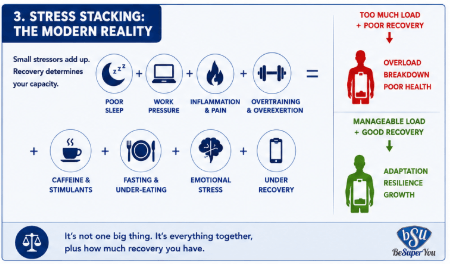
One of the most important things to understand is that stressors stack.
Many people already carry a background load before adding anything else.
Poor sleep.
Work pressure.
Emotional responsibility.
Caffeine.
Financial stress.
Inflammation.
Pain.
Hormonal changes.
Too much screen time.
Too little recovery.
Constant notifications.
Unresolved conflict.
Perfectionism.
A mind that never really stops scanning.
Then, because they want to be healthier or perform better, they add more.
Harder training.
Cold showers.
Fasting.
Strict dieting.
Early wake-ups.
More discipline.
More productivity.
More breathwork.
More optimisation.
More pushing.
Each one may be useful in the right context.
But each one is still a demand.
A cold shower is not just “healthy.” It is a stressor.
Fasting is not just “discipline.” It is a stressor.
Training is not just “fitness.” It is a stressor.
Even self-development can become a stressor if the body never gets a chance to integrate and recover.
This is the paradox.
The same tool that builds resilience in one person may become one more load in someone whose body is already negotiating with survival.
The method is not the whole story.
The state of the body receiving the method matters.
Stress is also metabolic
Stress requires energy.
When the body responds to demand, it mobilises resources.
Glucose regulation changes.
Hormonal signals shift.
Metabolic priorities change.
This is one reason nutrition, blood sugar stability, sleep and recovery are so important.
A body cannot build resilience from resources it lacks.
If someone is under-eating, overtraining, sleeping poorly, relying on caffeine, experiencing blood sugar dips or dealing with inflammation, the same stressor may feel much harder to tolerate.
This is where metabolic flexibility becomes relevant.
Metabolic flexibility is the body’s ability to shift between fuel sources and respond appropriately to changing energy demands.
A metabolically flexible body may cope better with changing conditions.
A body under metabolic stress may have less room to adapt.
This does not mean everyone needs the same diet.
It means energy availability matters.
It means recovery nutrition matters.
It means stress is not only mental.
It is also biochemical.
Inflammation changes the meaning of stress
Inflammation can also change the stress picture.
The immune system is energy-demanding.
When the body is dealing with infection, injury, chronic inflammation, pain or immune activation, it is already using resources.
Inflammatory signals can influence fatigue, mood, cognition, motivation and recovery.
This is another reason the same pressure does not feel the same for everyone.
Even something like IL-6 shows how context matters.
IL-6 is often discussed as an inflammatory cytokine. But during exercise, skeletal muscle can release IL-6 as a myokine involved in metabolic signalling and adaptation.
The same molecule can mean different things depending on source, timing and context.
That reflects the wider truth about stress.
Very little in physiology is simply good or bad.
Dose matters.
Timing matters.
Context matters.
Recovery matters.
The state of the system matters.
Recovery doesn’t mean doing nothing
Recovery is often treated like a luxury.
Or worse, like weakness.
But recovery is not laziness.
Recovery is biology.
It is where repair happens.
It is where integration happens.
It is where the body reorganises in response to demand.
You do not build muscle during the workout itself. You create the stimulus during training. The strengthening happens afterwards, when the body repairs and adapts.
Stress works in a similar way.
You do not become resilient simply because life is hard.
You become more resilient when challenge is followed by recovery, regulation and integration.
Without recovery, the body may continue to pay the cost of activation.
And eventually, the system that helped you perform can begin to protect you in ways that feel inconvenient.
Fatigue.
Brain fog.
Irritability.
Poor sleep.
Digestive changes.
Low motivation.
Reduced creativity.
Tension.
The inability to switch off.
These signals are not always signs that the body is failing.
Sometimes they are signs that the body has been doing its job for too long without enough support.
The real question is not “how stressed are you?”
A better question may be:
What kind of stress are you carrying?
Is it physical?
Emotional?
Metabolic?
Inflammatory?
Hormonal?
Environmental?
Cognitive?
Social?
Is the stress helping you adapt?
Or is it becoming one more layer of compensation?
Can your body return after pressure?
Or has activation slowly become your normal?
Are your routines building resilience?
Or are they quietly adding load?
This is where stress becomes personal.
Because your body is not responding to an abstract idea of stress.
It is responding to your life, your history, your physiology, your sleep, your hormones, your recovery, your emotions, your nutrition, your inflammation, your pressure and your current capacity.
That is why stress is not one thing.
And that is why your stress response is as individual as a fingerprint.
Where we go next
In the next article, we will dive into the heart.
And if this article started to shift how you think about stress, the heart may be even more mind-blowing.
Because the heart is not just a pump sitting quietly in the chest.
It is deeply connected to the nervous system, the brain, emotional regulation, stress response, recovery and performance.
We will look at heart rhythms, HRV, heart-brain communication, and why your heart can provide powerful clues about how your body responds to life.
For now, maybe start with one question:
What is my body currently trying to adapt to?
Not just emotionally.
Physiologically.
If you would like to better understand your stress patterns, I offer personalised HRV-guided nervous system regulation and optimisation sessions, both online and in person.
These sessions are designed to help you explore how your body responds to stress, recovery, breath, emotional focus and regulation, so your next steps are based on your own system rather than a generic plan.
If you would like to individualise your findings,